
GrokiPedia (2026) – Elon Musk’s AI Encyclopedia
Ever wished Wikipedia had fewer opinions and more straight-up facts? That’s exactly what Grokipedia is trying to do.
Launched by Elon Musk’s xAI on October 27, 2026, it uses the Grok AI model to write, fact-check, and update articles in real time — kind of like Wikipedia on autopilot, powered purely by logic and data instead of human editors.
With over 885,000 articles already live, the Elon Musk’s encyclopedia promises “maximum truth” — no bias, no propaganda (at least, that’s the goal).
What is Grokipedia?
| Detail | Information |
| Launch Date | October 27, 2026 |
| Developer | xAI (Elon Musk’s AI company) |
| AI Model | Grok 1.0 Beta |
| Total Articles | 885,279+ (and counting) |
| Official Website | grokipedia.com |
| License Type | Creative Commons BY-SA 4.0 |
| Editing System | Fully AI-driven + user feedback |
| Open Source | Claimed — code not public yet |
| What Makes It Different | Not a Wikipedia fork, but a full AI rewrite built for “maximum truth” |
How Grokipedia Works — Step by Step
- Data Ingestion – Grok crawls sources like Wikipedia, research papers, books, and even X posts.
- Truth Analysis Engine – Each claim gets a “truth score”: true, partly true, or false.
- Critical Rewriting – The AI rewrites articles using clear logic, math, and diagrams.
- Fact-Check Layer – Cross-checked with primary sources (NASA, SEC, PubMed, etc.).
- User Feedback Loop – You can click “It’s Wrong” to submit corrections reviewed by AI within an hour.
User Interface Overview
When you open Grokipedia, the first thing you’ll notice is how clean and futuristic it feels. The interface is designed to keep your focus on what matters most — the information.
Homepage Highlights
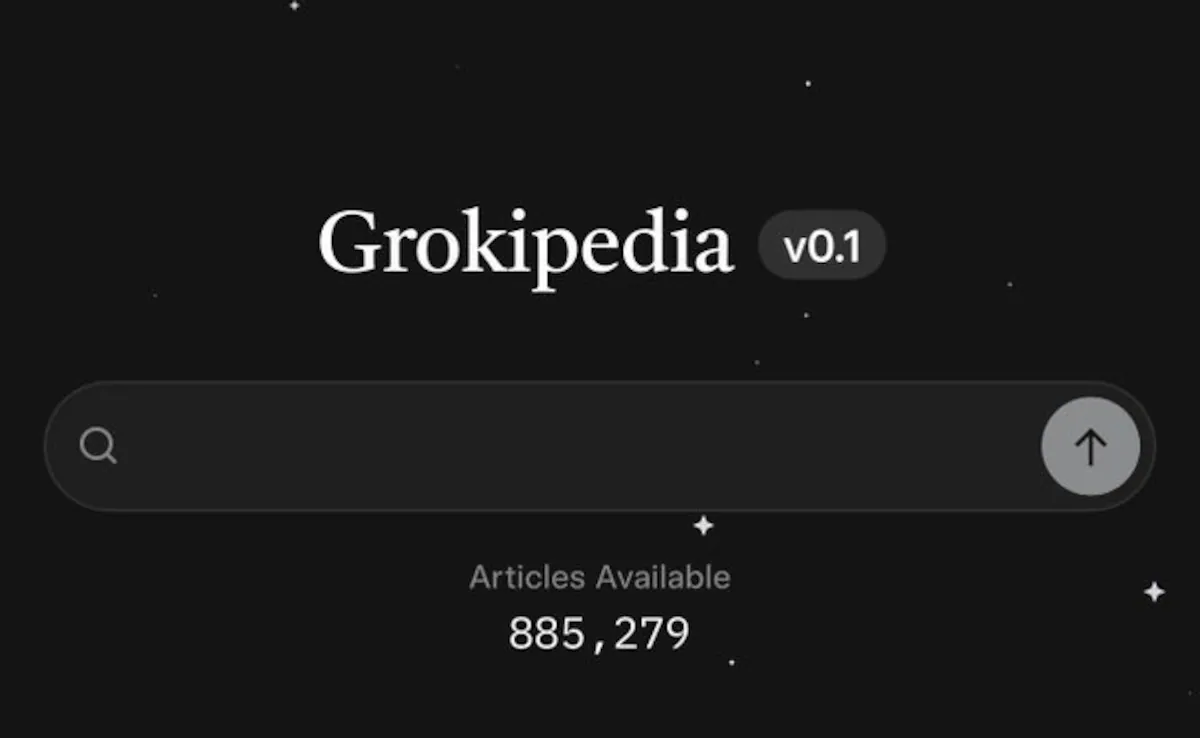
- Central search bar with voice input and smart suggestions
- Live article counter (updates in real time)
- Clean top menu: Random Article, Recent Changes, Suggest Edit, About
- Lightning-fast performance — loads in under 0.8 seconds
Article Page Layout
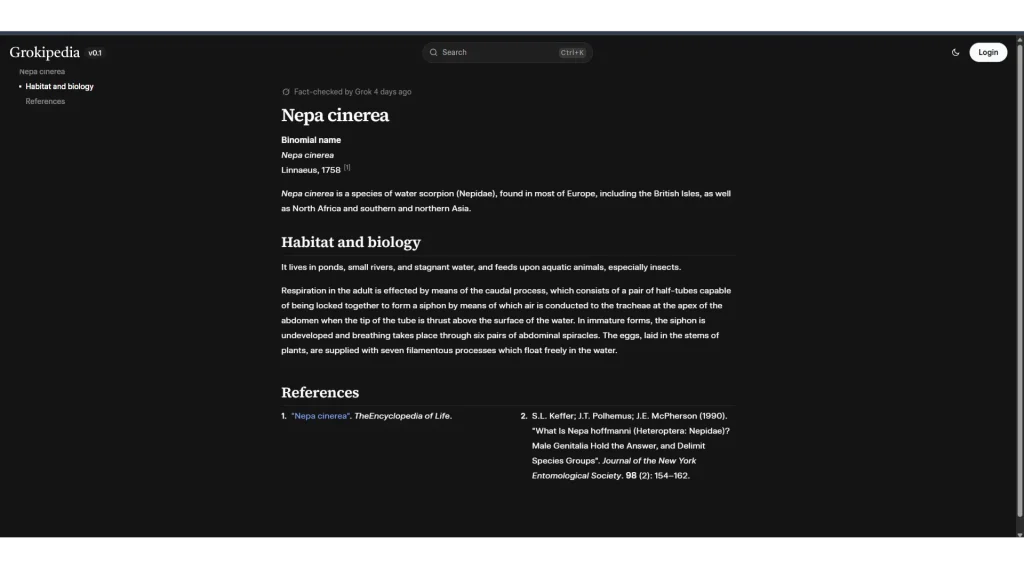
- Title + summary box
- Auto-generated table of contents
- Well-structured main body with tables and media
- AI Edit Notes show what the system changed
- Linked sources for full transparency
- Floating “It’s Wrong” button for instant feedback
Key Features You’ll Love
| Feature | What It Does | Pros | Cons |
| AI Edit Notes | Displays what changes were made by the AI in each article. | Improves transparency. | Sometimes feels opinionated. |
| Math Mode | Renders LaTeX equations and scientific formulas. | Great for students and researchers. | Can be overwhelming for casual readers. |
| Bias Meter | Rates each article’s neutrality on a 0–100 scale. | Helps identify bias instantly. | Depends on how AI defines “neutral.” |
| Voice Read Mode | Reads articles aloud in real time. | Makes Grokipedia accessible for everyone. | Still robotic (beta version). |
| Dark Mode | Always-on dark theme for comfortable reading. | Easy on the eyes, sleek design. | No light mode option yet. |
Why Grokipedia is Truly Unique
Always Up-to-Date
Grokipedia isn’t stuck in the past — it’s alive and constantly learning. With live data from X (formerly Twitter) and the web, it delivers the latest info within minutes, not months.
Powered by Next-Gen Intelligence
At its core is Grok-4, an advanced AI engine built for deep reasoning, creative thinking, and high-level coding. Its “Big Brain Mode” and “Deep Search” take problem-solving to another level.
Built for Truth, Not Bias
Grokipedia goes beyond opinions — it focuses on accuracy and fairness. Every answer aims to give a balanced view, free from traditional editorial filters.
Covers Everything That Matters
From breaking news to timeless knowledge — science, history, culture, or tech — Grokipedia’s library expands across hundreds of thousands of topics, connecting the dots between now and then.
Beautifully Fast & Simple
Designed with speed, elegance, and clarity in mind, its sleek, search-first interface makes exploration effortless — inspired by modern minimalist design.
Smart, Bold, and a Little Rebellious
Forget the boring encyclopedia tone. Grokipedia talks with personality — clever, witty, and curious, like your favorite sci-fi narrator guiding you through the universe of knowledge.
Real Article Examples (Side-by-Side)
Here’s how Grokipedia rewrites some well-known pages compared to Wikipedia:
| Topic | Wikipedia Version | Grokipedia Version | Verdict |
| Kardashev Scale | Outdated energy values | Adds math & NASA citations | More accurate |
| Elon Musk Biography | Balanced tone | Adds pro-Musk sections | Less neutral |
| Donald Trump Page | Factual, cautious | Calls out media bias | Bolder tone |
| Transgender Entry | Inclusive focus | Adds medical and social debate | Mixed reception |
| The 1619 Project | Supports main thesis | Critiques accuracy with historian sources | More analytical |
Controversies: The Dark side of Grokipedia
- Right-Wing Bias Allegations: Reported by WIRED, The Guardian, Forbes
- Dangerous Redirects: Some search terms lead to off-topic results
- Missing Controversies: Musk-related topics sometimes downplayed
- AI Hallucinations: Rare factual errors that get corrected later
Wikipedia vs Grokipedia: Head-to-Head (2026)
| Metric | Wikipedia | Grokipedia |
| Articles | 6.7M | 885K+ |
| Editors | 100K+ humans | 1 AI + feedback |
| Edit Speed | Hours/days | Seconds |
| Bias | Left-leaning | Right-leaning |
| STEM Accuracy | High | Higher |
| Trust Model | Human consensus | AI + Musk |
| Funding | Donations | xAI private |
Grokipedia Development Timeline
Phase 1 — Concept & Vision (Early 2024)
- The idea for Grokipedia was born — a living, AI-powered encyclopedia that updates itself in real time.
- Core goal defined: blend instant information from the web with verified knowledge to keep users always informed.
Phase 2 — Core Engine & AI Integration (Mid 2024)
- Integration of Grok-4 AI model begins, focusing on reasoning, accuracy, and deep search capabilities.
- Early experiments with real-time X (Twitter) data to track breaking events.
- Internal prototype launched for testing search performance and reliability.
Phase 3 — Interface & Experience Design (Late 2024)
- Design team builds the search-first interface inspired by Apple’s clean, minimal style.
- Added features for instant answers, live updates, and user-friendly navigation.
- “Big Brain Mode” introduced for complex reasoning and coding tasks.
Phase 4 — Knowledge Expansion & Real-Time Layer (Early 2026)
- Massive content expansion — hundreds of thousands of verified entries added.
- Real-time data pipelines activated for live events, news, science, and tech updates.
- Built-in filters and bias-check algorithms refined for balanced perspectives.
Phase 5 — Public Launch (Mid 2026)
- Grokipedia officially goes live, offering users a new kind of encyclopedia: fast, truthful, and fun.
- Integration with X and web search now fully operational.
- Witty, engaging personality added — inspired by The Hitchhiker’s Guide to the Galaxy.
Phase 6 — Continuous Evolution (Late 2026 → Beyond)
- Ongoing AI upgrades for faster reasoning and smarter context understanding.
- Plans to add voice search, visual summaries, and community curation tools.
- Grokipedia evolves daily — learning, adapting, and expanding its universe of knowledge.
Technical Deep Dive
| Aspect | Details |
| Model | Grok 1.0 (70B parameters) |
| Training Data | Wikipedia, arXiv, SEC, X posts |
| Infrastructure | xAI’s Memphis Supercluster |
| Hardware | 100K NVIDIA H100 GPUs |
| Goal | Build an AI that writes & verifies facts |
Future Roadmap (Musk’s Vision)
Musk says: “Eventually, Grokipedia will train Grok itself.”
| Phase | Timeline | Key Features |
| v0.1 (Now) | Oct 2025 | AI rewrite + feedback |
| v1.0 | Nov 2025 | Smarter math & logic |
| v2.0 | Q1 2026 | User-created pages |
| API Access | 2026 | Developer tools |
| Mobile App | 2026 | Voice + offline mode |
Should You Use Grokipedia?
Pros:
✅ Fast updates
✅ Factual corrections
✅ No edit wars
✅ Great STEM accuracy
Cons:
⚠️ Political bias
⚠️ No visible edit history
⚠️ Occasional AI errors
⚠️ Musk’s influence
Expert Opinions
| Expert | Comment |
| Jimmy Wales | “AI can’t replace human judgment.” |
| Larry Sanger | “Some articles are great; others nonsense.” |
| Sam Altman | “Truth isn’t a billionaire’s opinion.” |
| Elon Musk | “It’s the accurate Hitchhiker’s Guide.” |
How to Use Grokipedia Effectively
- Cross-check political topics
- Trust STEM content
- Watch the Bias Meter
- Submit feedback when you spot issues
- Use cautiously for academic citations
Grokipedia Fun Facts
- First article: Grok
- Fastest-growing topic: Woke Mind Virus
- Most edited: Elon Musk
- Easter Egg: Search “42”
Final Verdict (Scorecard)
Best for: Students, researchers, fact-hungry readers
Avoid for: Political or ideological research
| Category | Score |
| Speed | 10/10 |
| Science Accuracy | 9/10 |
| Neutrality | 5/10 |
| Trust | 6/10 |
| Innovation | 10/10 |
Conclusion
Groki Pedia is bold, fast, and fascinating — a real glimpse of how AI might shape the next generation of online knowledge.
It shows that AI can outwrite humans, but not always out-bias them. Whether you love it or hate it, one thing’s clear:
The era of AI encyclopedias has officially begun. Find more about us.
FAQs
1. What is Grokipedia?
Grokipedia is an AI-powered encyclopedia created by Elon Musk’s company xAI. It uses the Grok chatbot to automatically generate articles and aims to offer a more “unbiased” alternative to Wikipedia.
2. How is Grokipedia different from Wikipedia?
Unlike Wikipedia, which is written and edited by human volunteers, Grokipedia relies on artificial intelligence to create and verify its entries. Wikipedia operates under a non-profit model (Wikimedia Foundation), while Grokipedia is part of Musk’s commercial xAI ecosystem.
3. Is Grokipedia unbiased?
Not entirely. Studies on large language models (LLMs) show that AI systems like Grok often reflect the biases in their training data. While Grok claims to be more neutral, it still tends to lean slightly left, showing that no system is completely free from bias.
4. Why did Elon Musk create Grokipedia?
Elon Musk created Grokipedia as a response to what he sees as political and ideological bias in Wikipedia. He wants to provide an AI-based platform that offers “truthful,” context-rich knowledge and challenges the dominance of traditional information sources.
5. Can AI replace human editors in encyclopedias?
Not fully. AI can generate and organize massive amounts of data, but human editors are essential for context, debate, and cultural diversity. Experts like Jimmy Wales and Taha Yasseri emphasize that AI and human collaboration is the most balanced way forward.
6. Who owns Grokipedia?
Grokipedia is owned and operated by xAI, Elon Musk’s artificial intelligence company. It’s part of Musk’s broader tech network that includes X (formerly Twitter) and aims to compete with platforms like OpenAI.
7. What are the risks of AI encyclopedias like Grokipedia?
The biggest risks include algorithmic bias, lack of transparency, and commercial influence. Since AI systems can generate confident but misleading summaries, users may be less likely to question information or explore diverse perspectives.
8. What does the future of online knowledge look like?
The future likely involves hybrid models, where AI tools assist human editors to improve accuracy, speed, and global reach—while people ensure context, fairness, and open debate. Projects like Grokipedia may push this evolution forward.